


Gifting has never been easier
Perfect if you're short on time or are unable to deliver your gift yourself. Enter your message and select when to send it.


Awarded & authentic 100% Kona coffee
Taste Beyond Kona
Taste Beyond Kona

What Makes Kona Coffee Different?
Just like the Champagne grapes grown in the Champagne region of France, 100% Kona coffee can only be cultivated in a specific region of Hawaii: on the slopes of Hualalai and Mauna Loa in the North and South Kona Districts of the Big Island of Hawaii. But unlike Champagne, Kona coffees can be of any variety, just so long as they achieve certain state-regulated quality standards.
In other words, "100% Kona Coffee," it must be entirely from the Kona district and achieve USDA and the HDOA's quality and grading standards.
Heritage & Modern Kona Coffee Varieties
The Kona Typica variety is responsible for the soft, lush, chocolatey, and floral profile that's found in 100% Kona coffee. Because it has been grown in the district since 1832 – for more than 180 years - we refer to this as "heritage Kona coffee."
Among lighter roasts, flavor profiles range from smooth, chocolatey, and peach to jasmine, honey, and nougat.
Today, coffee growers are planting a range of exciting and exotic new varieties across Kona, such as SL-28, Geisha, Bourbon, Pacamara, Maragogipe, and more.
While these aren't the traditional varieties that made the region famous, they offer exciting new flavors and experiences for coffee lovers. The flavor profiles depend heavily on the specific varieties, but some of our favorites are Bourbon and Geisha.
Questions about Kona Coffee
Authentic 100% Kona coffee from Hawaii is special and revered for several reasons:
(1) Freshness: When you shop directly from local roasters like us, Kona and Hawaiian coffee doesn't require the same lengthy transportation times that non-US coffees do. In other words, Hawaiian coffee (including Kona coffee) is anywhere from 3 to 5 months fresher when it arrives at your door.
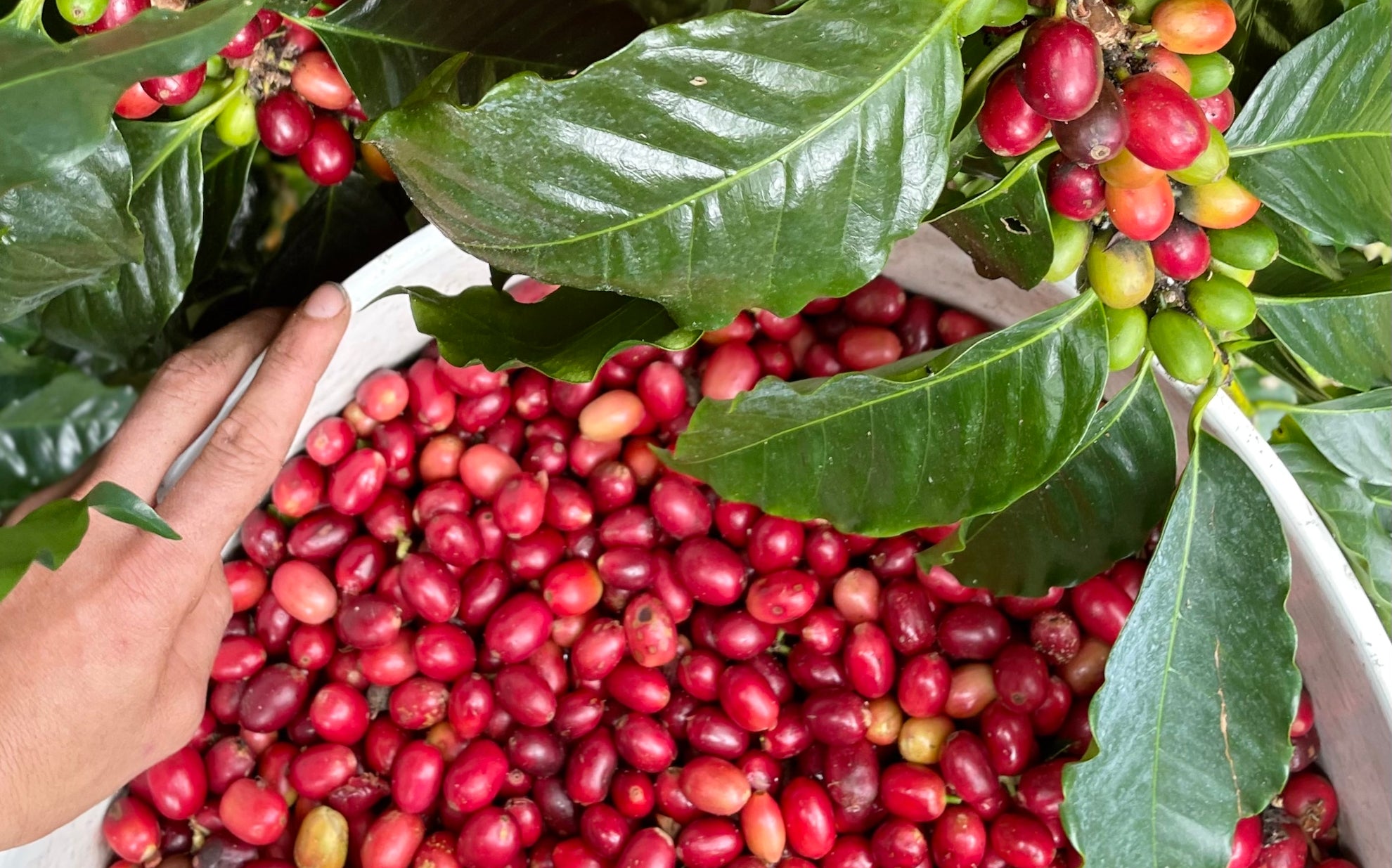
(2) Hand-harvested: Because Kona coffees are grown on an island with five volcanoes, the terrain is steep and rocky. That means mechanical harvesters can't be used. As such, even today, 100% Kona coffee is hand picked. The care that goes into harvesting ripe coffee cherries translates to a better, juicy, and sweet cup of coffee.
(3) Rarity: Because less than 1% of all coffee in the world is grown in Hawaii, it's rare to find 100% Kona coffee elsewhere.
Maybe unsurprisingly, Kona coffee comes from farmers in the Kona coffee region, on the western coast of the Big Island. The sloped, 30-mile-long strip of land is located on volcanic soil.
The western slopes receive the ideal amount of rainfall, sunshine, and consistent temperatures that allow the coffee crop to thrive. The minerals in the rich volcanic soil of this region also help give Kona coffee its distinct taste.
The best Kona coffee changes each year and varies between competitions, reviewers, and varieties. And, of course, your personal taste will also determine which Kona coffee is best.
In the past, Kona Peaberry, Kona Geisha, Kona Mokka, and heritage-style Kona Typica have all ranked high in competitions.
Almost always, the highest-ranked best Kona coffees from Hawaii have the same few things in common::
(1) They're family or estate-grown.
(2) The owners are hands-on and have deep technical knowledge of coffee farming and processing.
(3) The raw coffees are stored in hermetic GrainPro bags.
(4) The family has worked in the industry for several years.
(5) Someone in the family or in the company has a Q certification from the Coffee Quality Institute.
(6) They're both rare and expensive (for good reason).
TIP: If you find Kona coffee sold for $20/lb or less, there's a strong chance that the quality is abhorrent, or that it will be counterfeit.
Before we owned a farm and a roastery, we thought all Kona coffee was overrated. So, it's easy to understand why you would wonder if this is the case after seeing the price.
However, after more than a decade in the Hawaiian coffee industry, our experience is that around two-thirds of Kona coffee is overrated, while the remaining one-third is completely underrated.
Think of it like tasting a fresh-harvested heirloom tomato compared with one that's flown in from a distant country after being harvested while still green on the vine. The difference is powerful – and unforgettable!
This is similar to the experience of tasting ripe, freshly milled and roasted 100% Kona coffee for the first time. It's smooth and sweet, with a flavor that is both powerful and nuanced without being overbearing. We’re often told that it’s hard to go back to regular coffee after a few cups of farm-fresh Kona coffee.
As a coffee lover, the trick and challenge is finding the best and avoiding the overrated Kona coffees. Much like how it took you years to find your favorite blend, it’s a matter of weeding through the “just okay” Kona coffees to find a gem. But by shopping from us, you can skip the guesswork and enjoy the perfect cup of authentic, high-quality Kona coffee every time.
The level of caffeine in Hawaiian Kona coffee is similar to other arabica coffees.
Caffeine levels in arabica coffee, broadly speaking, sit at around 1.5%. This will vary depending on how you brew your cup and how concentrated you drink it. Kona coffee is no different.
This makes it easy to incorporate Kona coffee into your morning routine without shocking your system.
At $2 to $3 per cup, some wonder if Kona coffee is worth the price. However, for others, there's nothing better than opening a bag of roasted-to-order local coffee, sustainably grown by American farmers and delivered to their door.
What really matters is which Kona coffee you bought, and what price you're willing to pay.
As we mentioned earlier, in every coffee producing origin, the production quality is a bell curve. There's always some awful coffee, a lot of mediocre coffee, and a little top-tier Kona coffee.
If you want to shop Kona coffee from Hawaii that's worth the price, stick to these top-tier Kona coffees. They'll cost you between $2 and $4 per cup when you brew at home. And when you put that in perspective, it’s not much different than treating yourself to a cup from your favorite coffee shop.
Some think Kona coffee is expensive because it's the best coffee in the world. This isn't necessarily true (though we wish it were).
Just like every coffee producing origin, the production quality is like a bell curve. There's some awful coffee, a lot of mediocre coffee, and a small amount of top-tier, fantastic Kona coffee. It all depends on how it's grown, harvested, processed, and roasted.
The real reasons Kona coffee is expensive are because:
(1) It's always hand-harvested.
(2) Everyone in the supply chain earns a living wage.
(3) Kona coffee is rare, so there are supply and demand issues.
(4) There's not much agricultural land available in Kona, so the price of production is very high.
When you shop Kona coffee from us, you’re purchasing some of the highest-quality products available. The result is a better-tasting cup of coffee and an overall more enjoyable (and sustainable) sipping experience.
Authentic, heritage Kona coffees from Hawaii have a different flavor and mouthfeel than other coffees. This is partly because of the variety (Kona Typica) and partly because of the environment and rich volcanic soil.
The best Kona coffee tasting notes are usually chocolatey and rich, incredibly balanced, and smooth. Medium and light roasts have gentle fruity and floral notes. The variety of flavors available in our shop means you’re sure to find a roasted Kona coffee that appeals to your taste.